AC vs. Non-AC Taxi: How Do Prices Compare?
Deepak Chandra | Published Date 29-Oct-2026
Comparing AC vs. non-AC taxi fares? Discover typical per-km price differences, fuel impact, RTA tariff rules, and when paying extra for AC is worth it.
 AC vs. Non-AC Taxi: How Do Prices Compare? | AC vs. Non-AC Taxi: How Do Prices Compare?
When booking a taxi in India one of the common choices for travelers is to decide between an air‑conditioned (AC) taxi and a non‑AC taxi to see ac vs non-ac taxi how do prices compare. Many people use ride‑hailing apps and outstation companies that give ac cab booking as a normal option but non‑AC taxis, auto‑rickshaws and the usual black‑and‑yellow or local fleet taxis are still found in many cities. Knowing the difference in price how fuel works and the rules, for drivers can help a traveler decide if saving a hundred rupees is worth giving up some comfort.
Taxi Service in Delhi
View AllAC vs. Non-AC Taxi: How Do Prices Compare? Highlights
The Typical Price Difference
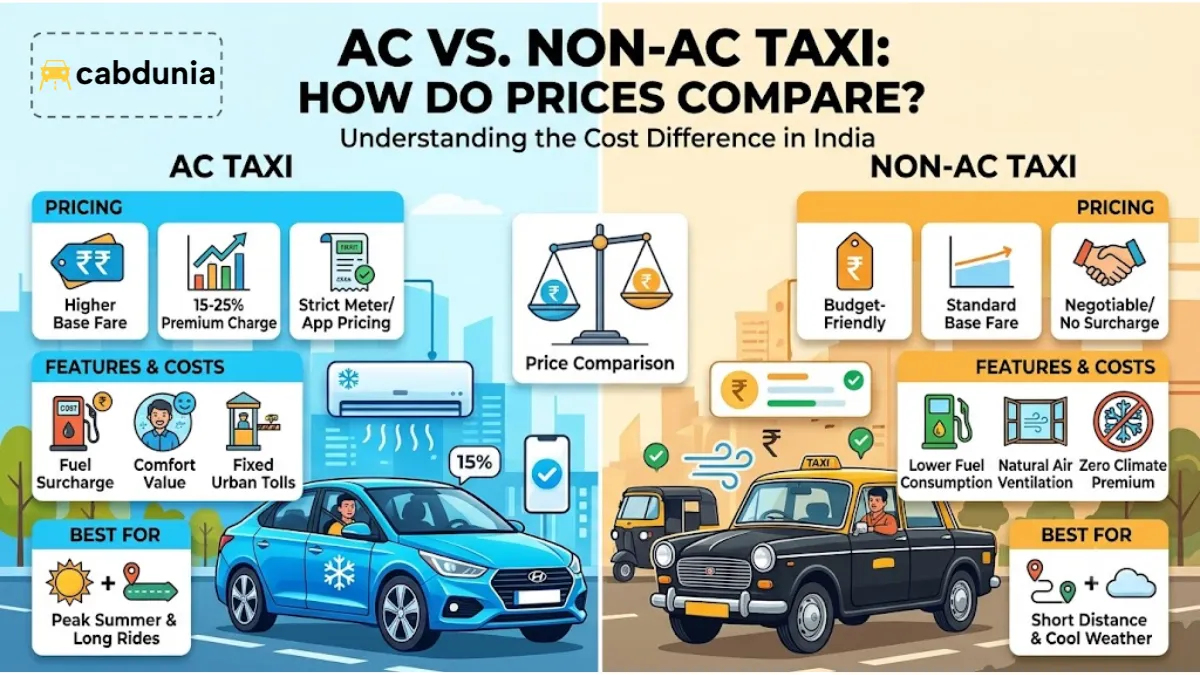
In the taxi market the ac vs non-ac cab rates and price difference between AC and non-AC cabs usually ranges from 10% to 25% of the total cost.
- Local City Rides: For hourly packages or metered trips non-ac taxi fare are generally charged between INR 1 and INR 3 less per kilometer than AC cabs. Looking at the taxi price difference per km, For example a non-AC hatchback might cost INR 9 to INR 11 per km while an AC hatchback usually costs INR 11 to INR 14 per km.
- Outstation Journeys: On long-distance highways dedicated taxi platforms charge outstation ac taxi rates and per-kilometer rates that include AC. However when non-AC options are available the difference often means a discount of INR 1.50 to INR 2.50 per km. On a 300 km trip this can add up to a saving of INR 450 to INR 750.
- State Regulations and RTA Tariffs: State Regulations and RTA Tariffs require that in Maharashtra, West Bengal and Delhi, Regional Transport Authorities, also known as RTAs set base fares and per‑kilometre tariffs for ordinary non‑AC taxis and for metered ac taxi charges. State Regulations and rta approved taxi fare set the rules so that the AC premium is generally capped at ten to twenty percent, above the standard metered rates.
Why Does the Price Vary?
The fare difference is driven by engine load and fuel consumption ac cab fare impact, and mechanical costs.
- Fuel Consumption: Running an air conditioner draws power directly from the vehicle engine through the compressor. In city traffic where the car idles a lot using the AC can increase fuel consumption by about 10% to 20%. Cab operators pass this fuel cost on to passengers.
- Maintenance and Wear: Air conditioning systems are made of compressors, filters and cooling parts that need care. Refrigerant gas has to be refilled and the battery has to work harder. All of this adds to the maintenance burden. Costs for the driver.
- Vehicle Tier: Taxis, without air conditioning are often models or basic commercial versions. These vehicles are cheaper to buy and insure so drivers can run them at profit margins.
Price & Feature Comparison
Parameter
Non-AC Taxi
AC Taxi
Average Per-KM Rate (City)
INR 9 – INR 12 / km
INR 11 – INR 15 / km
Typical Fare Premium
Base rate
+10% to +25%
Comfort & Dust Protection
Low (open windows, traffic exhaust)
High (sealed cabin, climate controlled)
Highway Suitability
Poor (wind noise at high speeds)
Optimal (aerodynamic efficiency with closed windows)
Best Use Case
Short 2–5 km hops, cool winter mornings
Long commutes, summer heat, highway travel
Making the Right Choice
When reviewing an ac vs non-ac taxi price comparison, Choosing a -AC cab can make sense for short trips of two to five kilometers especially during cool early mornings or mild winter afternoons. It also works well if you are on a daily travel budget. For longer journeys, like highway trips or city commutes during the afternoon an AC cab is the better choice. When you drive at speeds between 80 and 100 km/h, with windows down the wind resistance increases a lot. This drag reduces most of the fuel savings you might expect.. Passengers are left dealing with heat, loud noise and pollution from the roadside.

Get the List of Top Taxi Services
We’ll send you contact details in seconds for free
What Type of Taxi Services Do You Need?
Latest Posts
View AllAC vs. Non-AC Taxi: How Do Prices Compare? FAQs


 Use Current Location