How Is Taxi Fare Calculated in India?
Deepak Chandra | Published Date 17-Oct-2026
Discover why online cab booking is booming in India: smartphone growth, seamless UPI payments, doorstep convenience, upfront pricing, and trusted ride safety.
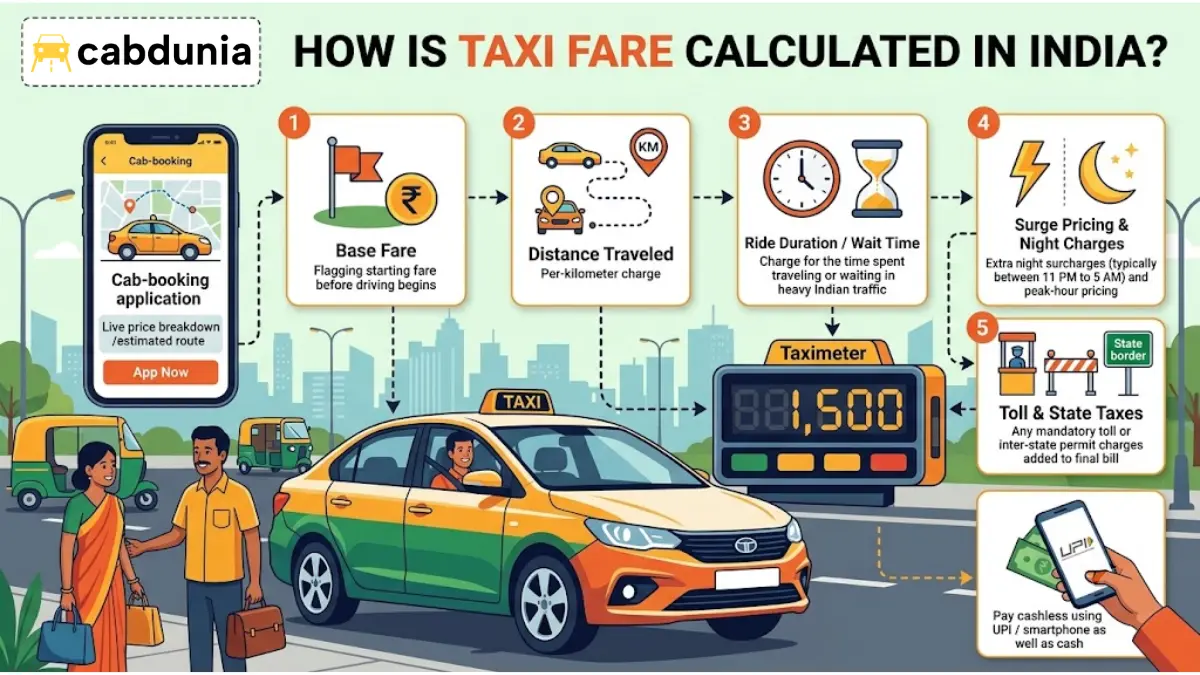 How Is Taxi Fare Calculated in India? | How Is Taxi Fare Calculated in India?
I booked a cab at a price that appeared clear. When I saw the bill I noticed a toll, a night charge and a line called "driver allowance." No one had explained any of these costs before I paid. This is probably the most common source of confusion for taxi booking in India. It is never, about overcharging; most platforms simply do not show the breakdown before you book.
Here is the actual formula. What each part means for the final bill
Taxi Service in Delhi
View AllHow Is Taxi Fare Calculated in India? Highlights
The Taxi Fare Formula
In India most cab fares follow this structure:
Base Fare + (Per-KM Rate × Distance)+ Toll + Night Surcharge (if applicable) + Driver Allowance (on longer trips)+ Gst.
Base fares usually range from INR 30 to INR 120 depending on the vehicle type and the city. Per-km rates are usually, between INR 9 and INR 25 depending on whether the vehicle's a sedan or an SUV and whether the booking is one-way or round‑trip. All other charges are added based on the details of the trip. Consider these figures as ranges; actual rates vary according on the operator, the city, and the time of year.
Base Fare — What It Actually Covers
The base fare is a starting charge that covers the few kilometers no matter what kind of vehicle you get. It usually costs between INR 30 and INR 120 depending on the city and the type of vehicle. A hatchbacks base fare is cheaper than an SUVs. This exists mainly to cover the operators fixed cost of sending a vehicle out separate, from the distance you actually drive.
| Vehicle Type | Typical Per-KM Rate (One-Way) | Typical Per-KM Rate (Round-Trip) |
|---|---|---|
| Hatchback | ~INR 9–13/km | ~INR 8–11/km |
| Sedan | ~INR 12–19/km | ~INR 10–16/km |
| SUV / Innova-type | ~INR 16–25/km | ~INR 14–22/km |
These are national estimate ranges, not fixed rates. Always confirm the exact per‑km rate at booking. Round‑trip per‑km rates usually run slightly lower, than one‑way per‑km rates because the operator recovers the return leg’s cost over a total distance instead of just a single point‑to‑point trip.
Toll Charges — Who Pays and When
Tolls are always billed separately at actuals on top of the fare. This is practice, not an extra fee that is being sneaked in. On expressway routes toll is predictable and worth checking in advance. For example the Mumbai-Pune Expressway runs about INR 320 one-way in toll for a car. Ask upfront whether your quoted fare is toll-inclusive or toll-additional. This single question avoids the common source of confusion about why the final bill is higher, than the quote.
Night Charges — When They Apply
Most operators apply a night surcharge, about 20–25% for trips that start between about 10 PM and 6 AM. The exact hours differ from one operator to another; some use 11 PM to 5 AM. This is not random; it mirrors the increase, in operating costs that drivers face when they work through the night. If your trip timing can change, moving a booking outside the night surcharge period is one of the ways to lower the fare.
Driver Allowance / Bata — The One People Forget About
On trips that go more, than 300 km in a day drivers often get an extra payment called "bata." This is usually a fixed amount each day INR 300 to INR 400. This payment helps with the drivers food and hotel stay when the trip is so long that the driver cannot go home the same day. It can be easy to overlook when looking at prices because this payment is not always shown in the first quote. It usually appears on the final bill. Always make sure to ask if this payment is part of the price you are looking at.
Peak/Surge Pricing
Peak‑hour surcharges, which are usually 10–20% can apply during times when traffic is heavy. These times are usually the morning and evening rush hours in cities or during festivals and holidays, on routes that go out of town. If you want to keep these fees out of your ticket the best way is to book a day or two ahead instead of waiting until the same day when demand is high.
Conclusion
Taxi fares aren’t hard to understand once you know the formula. It’s made up of a base fare a cost per kilometer tolls and a few extra charges that depend on the trip. Things, like night surcharges or driver allowances can add up. The best way to avoid surprises isn’t to skip these fees. Most of them are normal. The real solution is to ask for the fare breakdown before you confirm your ride. That way you know what you’re paying for.
Further Reading & Business Travel Guides

Get the List of Top Taxi Services
We’ll send you contact details in seconds for free
What Type of Taxi Services Do You Need?
Latest Posts
View AllHow Is Taxi Fare Calculated in India? FAQs
It should be listed as an item usually at 5 percent or 12 percent depending on the operator’s GST plan. Ask if it is not clear, from the quote.


 Use Current Location